Regarding Matters Discussed Over Coffee

London,
October 1695,
Near the Royal Exchange,
With rain on the cobbles and money in the air.
Most ports smell of tar.
Some smell of fish.
London smells of ambition.
We’d come for a matter too dull to deserve remembering. A disputed account. Missing payment. One merchant insisting another had settled it. The sort of disagreement that produces paperwork faster than coin.
Flint called it necessary.
Rumfellow called it tedious.
I called it a reason to watch who arrived first.
Had matters proceeded sensibly, we’d have been back aboard Treasure Bounty within two days.
Instead, we remained.
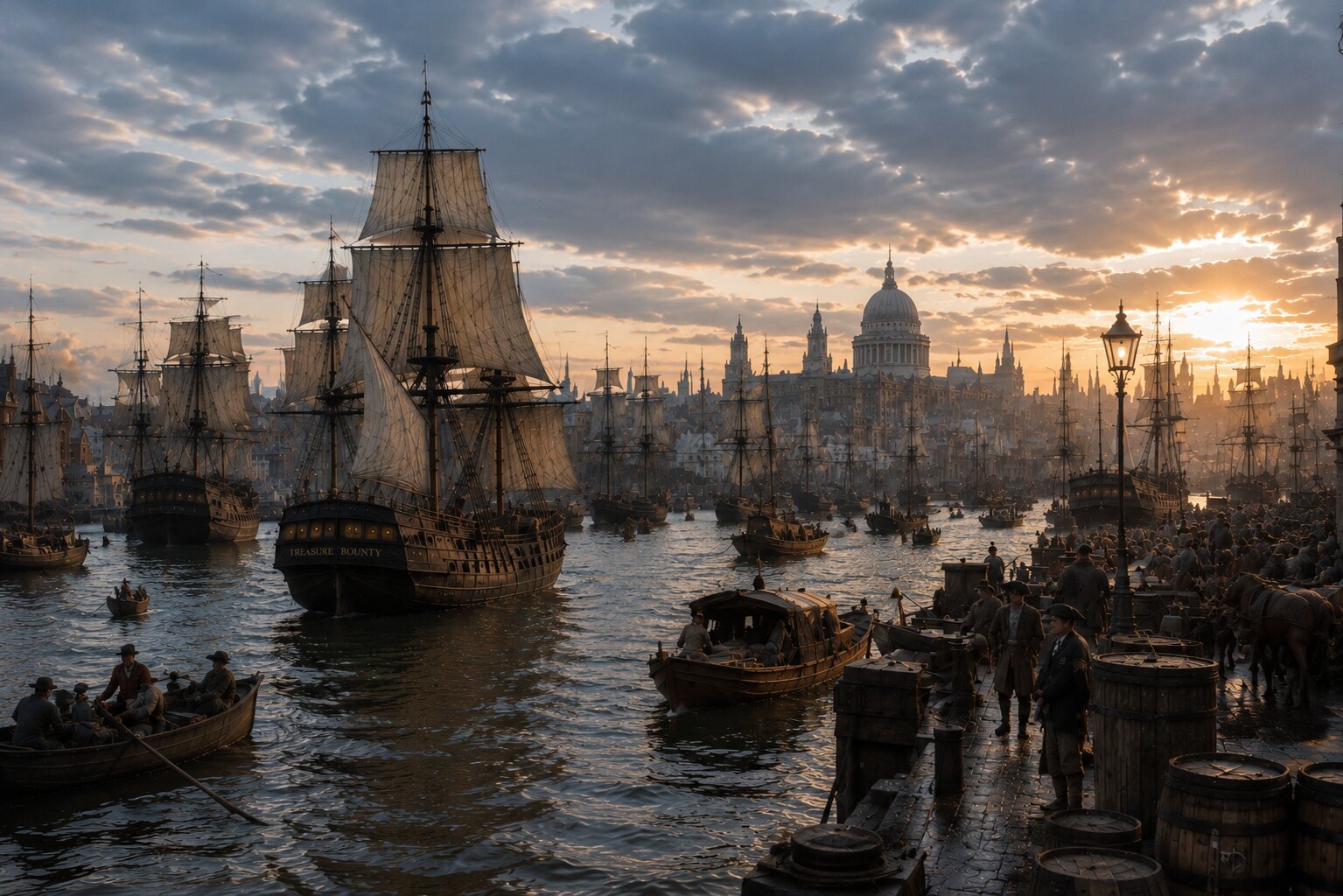
The Thames was crowded beyond reason. Barges, wherries, merchantmen, naval vessels, ferries, fishing boats, and things that appeared to be floating entirely on confidence. Every tide seemed to carry half the world upriver.
That interested me more than the account.
A city may pretend to be built of stone, but London was moved by water.
Finding a berth had been difficult enough.
Finding lodgings proved easier.
The river traffic had swollen the city beyond comfort, and many captains found themselves sleeping ashore whilst their vessels waited their turn amongst the forest of masts.
Treasure Bounty sat safely enough upon the river.
We did not.
A coffee house near the Royal Exchange offered rooms above and hot food below, and after a day spent chasing merchants who appeared determined not to be found, none of us felt inclined to argue.
The place stood upon a narrow street crowded with brokers, merchants, insurers, captains, factors, agents, clerks, and men whose occupation appeared to be knowing things before other people.
That last sort are always worth noting.
Its windows glowed amber through the evening rain.
Inside was warmth.
Coffee.
Tea.
Chocolate.
Pies.
Bread.
Cold meats.
And conversation.
Endless conversation.
That struck me first.
Not the coffee.
Not the crowd.
The arrangement of it.
Certain tables attracted visitors.
Others attracted listeners.
Some men spoke constantly and said very little.
Others said almost nothing and were interrupted repeatedly.
The room seemed to organise itself around information not yet available elsewhere.
There were no musicians.
No dice.
No drunken arguments.
No sailors attempting to settle matters with chairs.
Every table carried a discussion.
Ships arriving from Amsterdam.
Convoys bound for Lisbon.
Insurance rates.
Sugar prices.
Government borrowing.
Colonial ventures.
Cargoes not yet unloaded.
Wars not yet declared.
Victories not yet reported.
Rumours travelling faster than any vessel afloat.
What interested me was not the news itself.
It was who already seemed familiar with it.
A ship sighted in the Channel would be discussed by men who had never left London.
A cargo not yet unloaded already had interested parties.
A venture not yet announced appeared to have investors.
The pattern repeated itself throughout the room.
Some people arrive after events occur.
Others appear before them.
I have generally found the second group more useful to observe.
Rumfellow lasted perhaps ten minutes.
He stared suspiciously into a cup of coffee as though it had personally offended him.
“Folk pay money for this?”
“They do,” I said.
“Tastes like somebody boiled a boot.”
He abandoned the experiment shortly afterwards and announced his intention to locate a proper tavern before London entirely lost its senses.
We never saw him again that evening.
The rest of us remained.
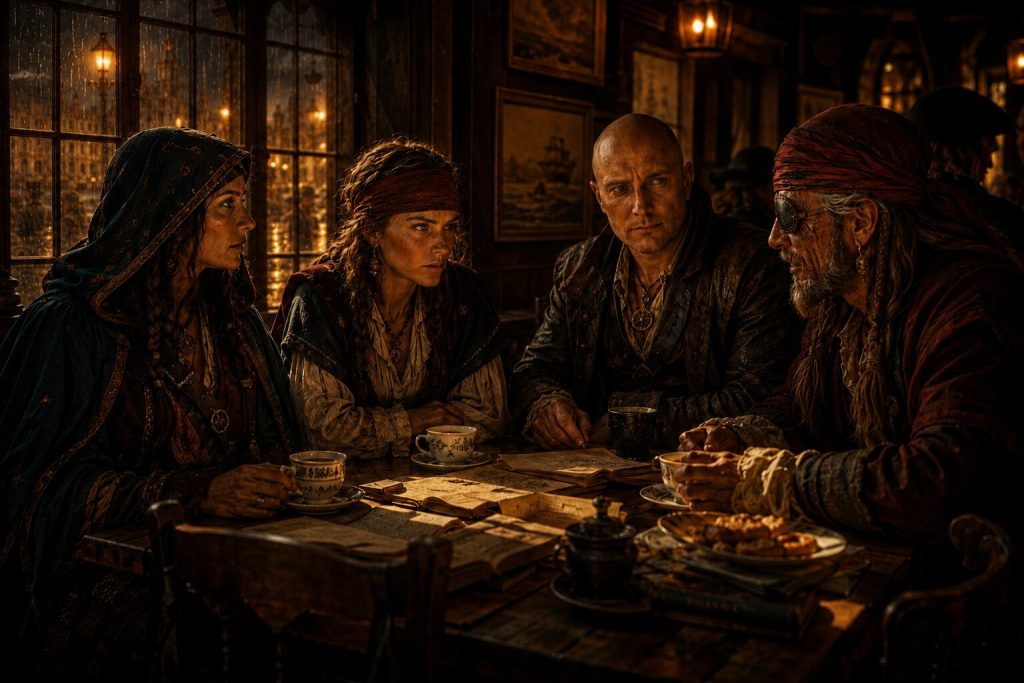
Lady Marrow watched the people.
Alex watched everything.
I watched who moved between tables.
The more I observed, the stranger the place became.
One merchant would arrive carrying news from Bristol.
An hour later men who had never left London were discussing it as though they had witnessed it themselves.
A ship sighted in the Channel became known at one table before the vessel itself had reached the Thames.
A government loan was discussed by men who spoke of it with the confidence of people already arranging themselves around it.
The same names appeared repeatedly.
Not loudly.
Not importantly.
Simply often.
A man here.
A conversation there.
An introduction made before a venture was announced.
A visit paid before a cargo arrived.
Certain people seemed remarkably skilled at appearing early.
I have learned to pay attention when that occurs.
The stories travelled from table to table, growing richer as they moved.
Yet what interested me was not the stories themselves.
It was the routes they followed.
Who carried them.
Who received them.
And who seemed unsurprised when they arrived.
By evening I found myself less interested in the account that had brought us to London and more interested in the room itself.
The merchant might settle his dispute.
The account would eventually balance.
But this place appeared to contain something far more useful.
Not certainty.
Not authority.
Not even information.
Anticipation.
The sense that certain people had developed a habit of standing where events would later occur.
Eventually the candles burned low.
The crowd thinned.
Clerks returned home.
Merchants settled their accounts.
The final cups were drained.
One by one we climbed the narrow stairs to the rooms above.
Through the window I could still see the masts upon the Thames and the lanterns of Treasure Bounty resting out amongst the traffic.
At the time, I believed we would settle our business and depart within the week.
Looking back, I suspect the matter that brought us to London had very little to do with why we remained.
Some places reveal themselves slowly.
Some patterns require patience.
This one had only just begun.
— Penny Doubloon