Regarding Cargo with No Taste for Waiting

Southampton,
30 June 1688,
Late evening, with rain threatening and common sense already absent.
I had no intention o’ becoming involved.
Experience has since taught me that such intentions rarely matter.
Treasure Bounty lay against the quay with a purse lighter than was desirable and a crew heavier than was affordable. Southampton had already relieved us o’ more coin than the voyage had earned, and I was beginning to suspect that remaining another week would see us reduced to selling parts o’ the ship in an orderly fashion.
The crew, naturally, appeared unconcerned.
That was when the gentleman arrived.
Not aboard.
Not dramatically.
Simply walking down the quay carrying a leather satchel beneath one arm and the expression of a man who had spent several weeks looking over his shoulder.
He asked for Cap’n Rumfellow.
I briefly considered introducing him to somebody else.
Unfortunately, no suitable volunteer presented himself.
“How do ye know my name?” I asked.
The gentleman glanced toward the harbour office.
“The harbour master gave me three names,” he said. “One captain was already at sea. Another was reportedly drunk before breakfast. The third was said to be available.”
“Available,” I said, “be a polite way o’ saying desperate.”
A corner of his mouth twitched.
“I was also told ye sail when others hesitate.”
“I generally sail when others are paying.”
That earned a proper smile.
His name, he explained, was Nathaniel Harcourt.
He required passage to Hellevoetsluis, the Dutch naval port.
Immediately.
No delays.
No additional passengers.
No unnecessary conversation.
The urgency interested me.
The purse interested me considerably more.
I asked whether he was fleeing a wife, a creditor, or the law.
He replied that all three had become increasingly difficult to distinguish.
That answer alone earned him a place aboard.
We agreed to leave before first light.
Mr Harcourt carried little with him.
One travelling case.
One satchel.
And one sealed letter which never seemed far from his hand.
I noticed him checking it often.
More often than he checked the weather.
More often than he checked the sea.
At one point he nearly dropped his purse into the harbour whilst ensuring the satchel remained safely under his arm.
That alone told me where the true value rested.
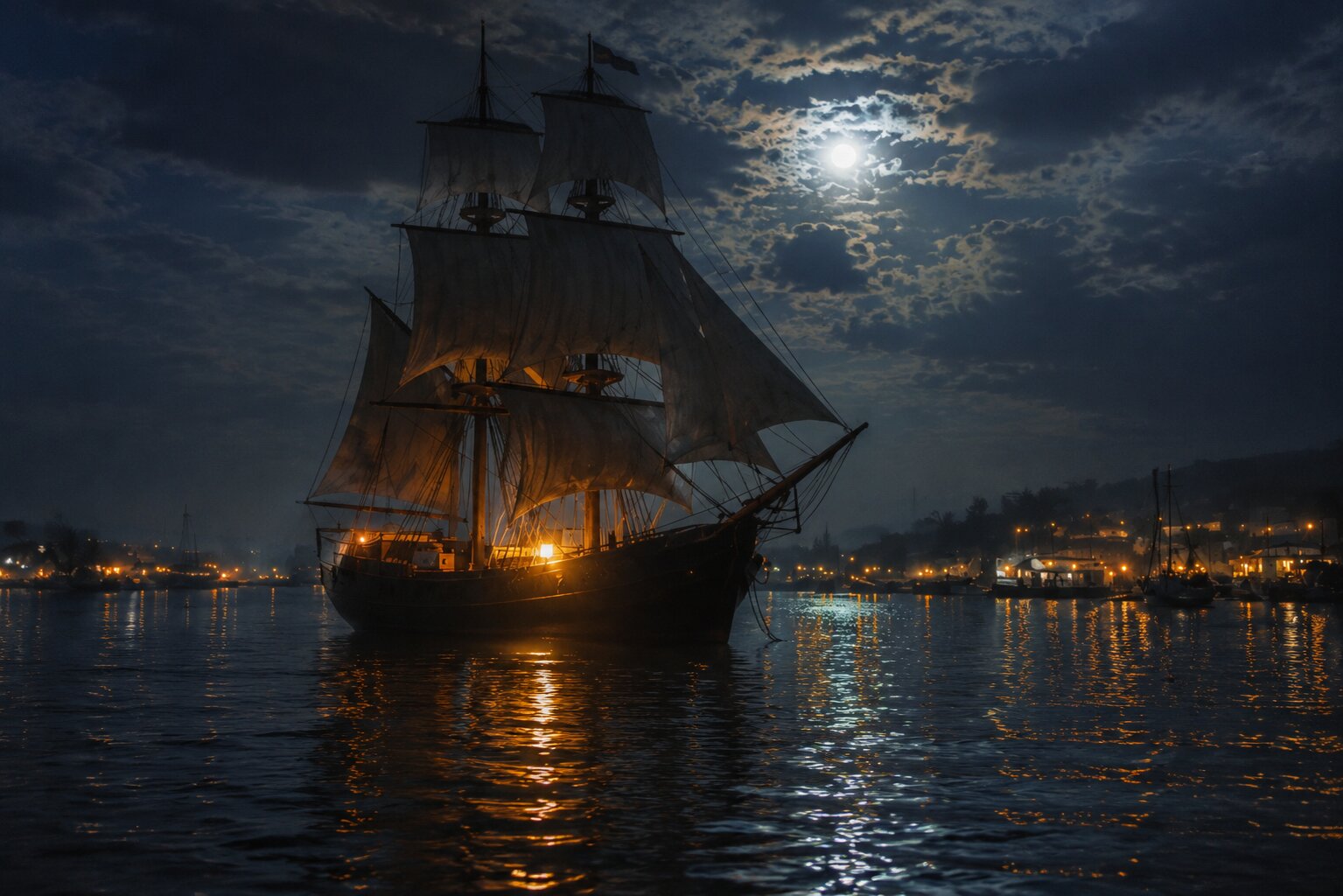
We slipped Southampton in darkness, lamps hooded, voices low, the tide doing its work with unusual manners. The town fell behind us without farewell.
By dawn, England had become a grey line.
By noon, Mr Harcourt had worn a path into the deck.
Twice I found him staring astern as though expecting pursuit.
Three times I caught him studying passing vessels.
Once, when a sail appeared too long upon our quarter, he went white enough to make even Flint take notice.
Whatever rested inside that letter carried more weight than the luggage.
Perhaps more weight than the man himself.
The Channel behaved better than men usually do.
The wind held.
The sea rolled.
The crew made sport of guessing what sort o’ trouble we were carrying.
Flint said debt.
Penny said politics.
Lady Marrow said inheritance, which is what she says whenever men behave foolishly in good coats.
Alex said nothing.
That worried me most.
By the time the Dutch coast rose from the morning mist, Mr Harcourt looked less relieved than newly endangered.
Hellevoetsluis appeared ahead of us — ordered, watchful, and too busy for a port pretending at peace. Masts stood thick. Naval stores moved under guard. Officers crossed the quays with sealed papers. Men spoke quietly and walked quickly.
Too much preparation.
Not enough explanation.
We came in under a modest face and were told where to lie.
Mr Harcourt paid precisely as promised.
Then, before stepping ashore, he handed me a small folded card, sealed with plain red wax.
“If a letter bearing this mark ever reaches you,” he said, “read it before refusing.”
I asked why I would refuse.
He looked towards the naval yards, where another cart of powder barrels was being moved under cover.
“Because, Captain, whatever follows will likely be less simple than this crossing.”
I told him crossings are never simple.
He almost smiled.
Then he offered his hand.
Respectable men do not often shake hands with men like me unless they have already run out of better options.
I took it.
“Should a letter arrive,” he said, “ask for me in The Hague.”
“Aye,” I replied. “And should one not arrive?”
“Then count yerself fortunate.”
With that he disappeared into the port, swallowed by officers, clerks, sailors, and all the quiet machinery of men preparing for something they had not yet named.
At the time, I thought little of it.
Men cross seas every day.
Letters travel farther still.
Only later would I learn that Mr Harcourt’s letter had been bound for a man called William of Orange.
And that some letters carry rather more than words.
Some carry kingdoms.
— Cap’n Rumfellow