A Matter of Licences and War

Barbican,
Saturday, 2 February 1793,
Near to dawn, though no one was counting,
I did not intend to mark the night.
The Minerva had other plans.
It began, as these things so often do, with a man who would not accept that the round was his, and ended with another man who would not accept my opinion on the matter. Words were exchanged. A chair took sides. I was encouraged — forcibly — to reconsider my position indoors.
So I found meself spilled out onto Looe Street, knuckles sore, coat askew, the air cold enough to wake a man even when the drink has failed to do so.
The Barbican lay quiet in that uneasy hour when the sea is awake but the town pretends otherwise. Lamps burned low. Water whispered against stone. I walked it off toward Sutton Wharf, then climbed, without much plan, toward the Citadel and on toward the Hoe.
It was there — half-blind with salt and pride — that I saw it.
Lights.
Low and disciplined.
Not the careless scatter of fishing boats returning late, nor the lonely patience of patrol craft. These were ordered lights. Practised lights. Lights belonging to men following instructions they had no intention of discussing.
Then hulls followed.
And more hulls after that.
Slipping past Drake’s Island like thieves who had paid their debts in advance.
Ships.
Naval.
Provisioned.
Moving with purpose and not a scrap of ceremony between them.
No music.
No signal.
No notice nailed to a door.
No crowd gathered to wave them off.
If this were routine, it would have been written.
If it were theatre, it would have drawn spectators.
It was neither.
And that set my teeth on edge.
I sat to consider it.
Then, unwisely, lay back to consider it further.
The grass upon the Hoe remains remarkably forgiving toward men who have made poor decisions.
I slept like one.
I was woken by a gull with the voice of a magistrate and the manners of a dockside thief.
By the time I staggered back down toward the Barbican, morning had fully committed itself. Bells rang. Bread appeared where none had business appearing so early. Plymouth had resumed its usual lie of normality.
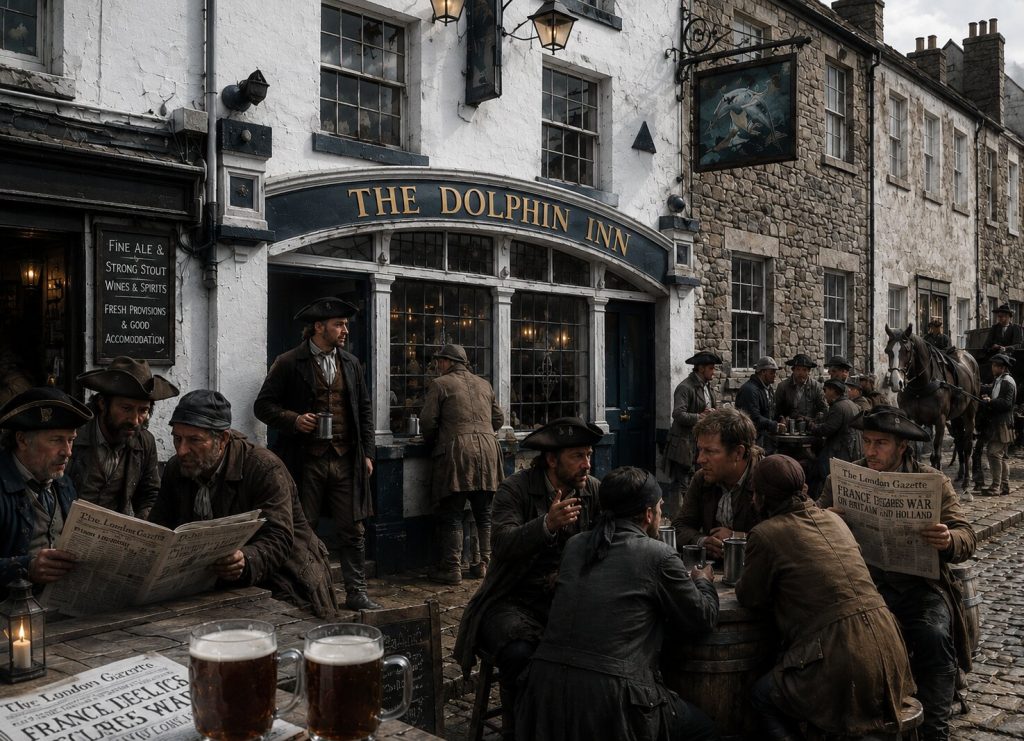
The Dolphin was open — bless it — and inside I found the town making considerably more noise than seemed necessary.
The place was crowded.
Sailors.
Merchants.
Captains.
Dock clerks.
A customs officer pretending not to be a customs officer.
Every table seemed occupied by somebody with an opinion and a drink.
More unusually, every table appeared occupied by a newspaper.
I ordered breakfast.
The woman behind the counter informed me I looked dreadful.
I informed her I was doing my best.
Neither of us believed the other.
Near the hearth a merchant was reading aloud from a London paper.
Poorly.
But loudly.
“…France…”
“…the King…”
“…executed…”
“…declaration…”
Most of the room only half-listened.
The words mattered less than the consequences.
“Aye,” said one old captain. “They’ve cut Louis’s head off and now they’ve declared war.”
Another shrugged.
“French have been causing trouble for years.”
“Aye,” came the reply, “but now they’ve put it in writing.”
That earned a murmur.
Further along the room, somebody mentioned the government.
Somebody else mentioned commissions.
A third mentioned privateering.
That quietened the room more effectively than the war.
One weather-beaten fellow with half an ear and twice the confidence leaned forward.
“Mark me,” he said. “Before summer every captain from Plymouth to Portsmouth will suddenly discover a deep affection for King and Country.”
Laughter followed.
“King and Country?”
“Aye.”
“Prize money, more like.”
More laughter.
Even I had to grant him that.
Another sailor tapped the newspaper.
“They’re saying Letters of Marque will be issued.”
That caught my attention.
A Letter of Marque is a curious thing.
One day ye’re a troublesome captain.
The next day ye’re a troublesome captain with official permission.
History contains many such improvements.
I was still considering this when Flint McLedger appeared, carrying a ledger and an expression suggesting he had already found fault with the day.
I slid onto the bench opposite.
“Tell me,” I said, “did ye see aught strange in the Sound, or is it my head that’s finally split clean in two?”
He did not look up.
He turned a page requiring no turning.
“I saw ships,” he said.
“Which means I saw nothing.”
“Which means something’s afoot.”
Lady Marrow arrived shortly after, hood drawn, gloves immaculate despite the weather.
I mentioned the newspapers.
She frowned.
“Kings losing their heads rarely improves matters.”
That was all she offered.
It was enough.
Alex Chartwright arrived next carrying three newspapers and an expression I have since learned usually means trouble is approaching in an organised fashion.
Penny arrived last.
Late.
Which meant she had been listening elsewhere.
“Three merchant captains delayed departure this morning,” she said.
“Why?”
“They won’t say.”
“Then how d’ye know?”
“Because they won’t stop talking about not saying.”
A fair point.
Outside, Plymouth carried on as though nothing had happened.
Inside, every conversation seemed to circle the same thing.
France.
War.
Shipping.
Commissions.
Privateering.
Opportunity.
The fleet had sailed before dawn.
The newspapers arrived after.
Which suggested to me that somebody already knew where matters were heading.
The rest of us were merely catching up.
I record this not as accusation, nor as tale for the telling, but as marker.
Something left Plymouth before it wished to be noticed.
Something larger appears to have begun.
And I have the uncomfortable feeling that the Treasure Bounty has been too long at ease.
— Cap’n Rumfellow