Regarding a Cargo That Should Have Stayed Stolen

Rum makes men careless.
Ports even more so.
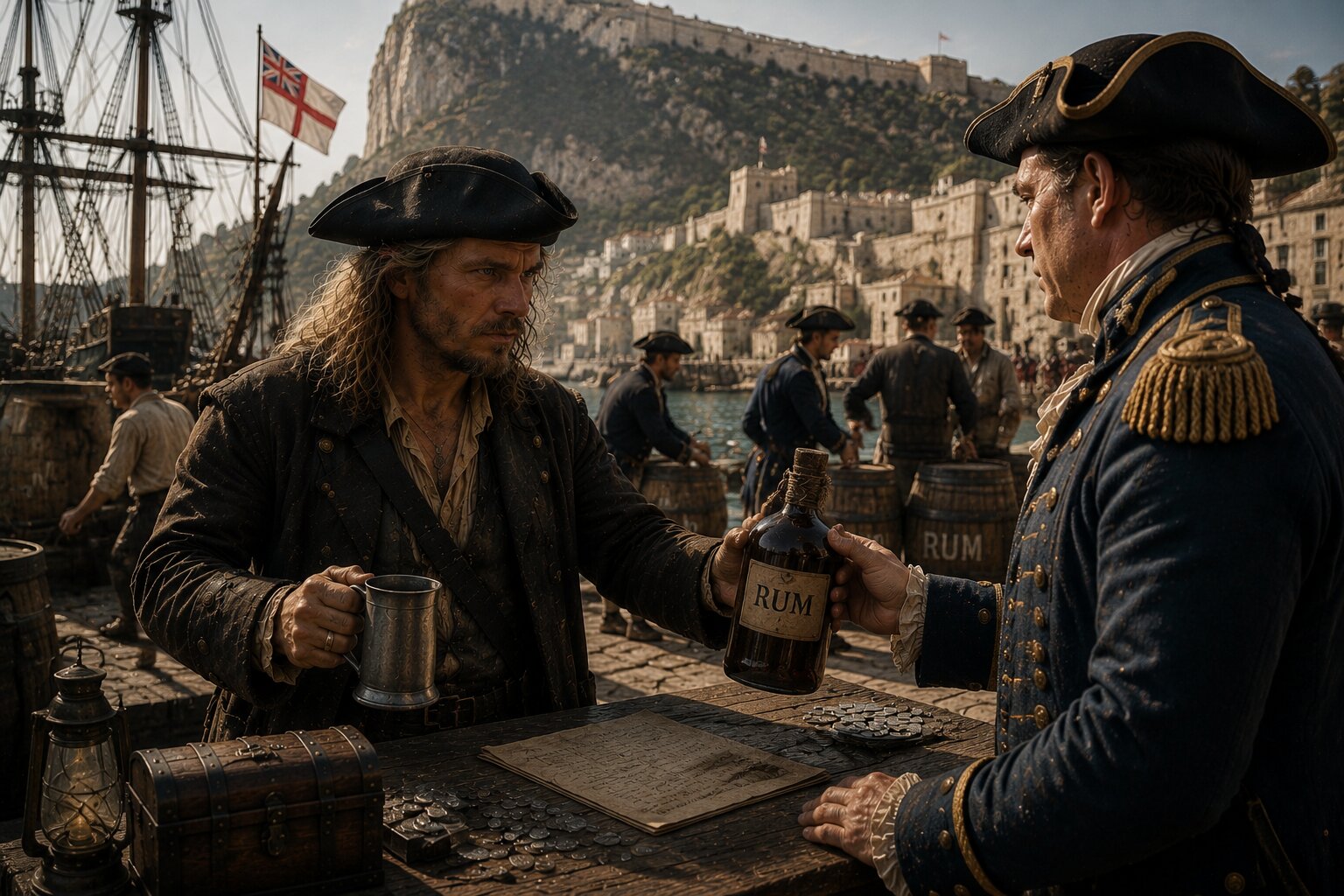
We were anchored off Jamaica, where the air is thick with sugar, sweat, and excuses, and Her Majesty’s colours hang lazy enough that no one looks too hard at what’s being counted. The docks were loud with song and clatter, rum flowing like it had no memory of who paid for it in the first place. Barrels stood stacked three high beneath canvas awnings, waiting on manifests, signatures, and men sober enough to remember which cargo belonged to whom.
That was our sort of night.
We waited until the fiddles ran long and the lanterns dipped low. Then we moved — soft boots, quick hands, no prayers wasted. Iron kissed wood, ropes creaked polite, and casks rolled down the pier gentle as babes into the longboat. Merchant rum travels best after dark. By the time the watch remembered they were meant to be sober, Treasure Bounty was already easing out, Jamaica shrinking behind us with all her noise and none of her blame.
A fine haul it was too. Heavy barrels, dark and strong, purchased honest enough and destined for thirsty men in distant uniforms. I reckoned the merchants would complain louder than the Crown ever would. Merchants always do.
We turned our nose east and let the Atlantic do the carrying. Weeks of blue water and salt rot, the crew sweetened by the joke of it all — stealing cargo bound for Her Majesty’s sailors, only to sell it back to them with coin in their pockets and thirst in their throats. Alex Chartwright kept the reckoning straight, quiet as ever, marking our days and distances like he was already writing us into something larger than trouble.
Gibraltar sits like a stone tooth at the mouth of the sea, all guns and flags and men pretending they don’t feel the weight of Europe breathing down their necks. The Rock needs rum. Always has. A sober garrison asks questions, and questions are bad for morale.
We came in under a merchant’s face and found our buyers quick enough — sailors with silver in hand, officers willing to look the other way so long as the cups stayed full and the men stayed loud. Half the cargo gone in a blink, sold dear, laughter thick as tar. I thought we’d played it clean.
That was my mistake.
We slipped out of the Strait at first light, sails high, spirits higher, England already counting itself in my head. I looked back toward the docks more out of habit than worry — and that’s when I saw it. Too much movement. Too sharp. Men running who should’ve been swaying. Boats cast off without the courtesy of delay.
I tasted iron.
“All canvas,” I told them. “Bleed her for it.”
The wind had other ideas. It gave us scraps and laughed.
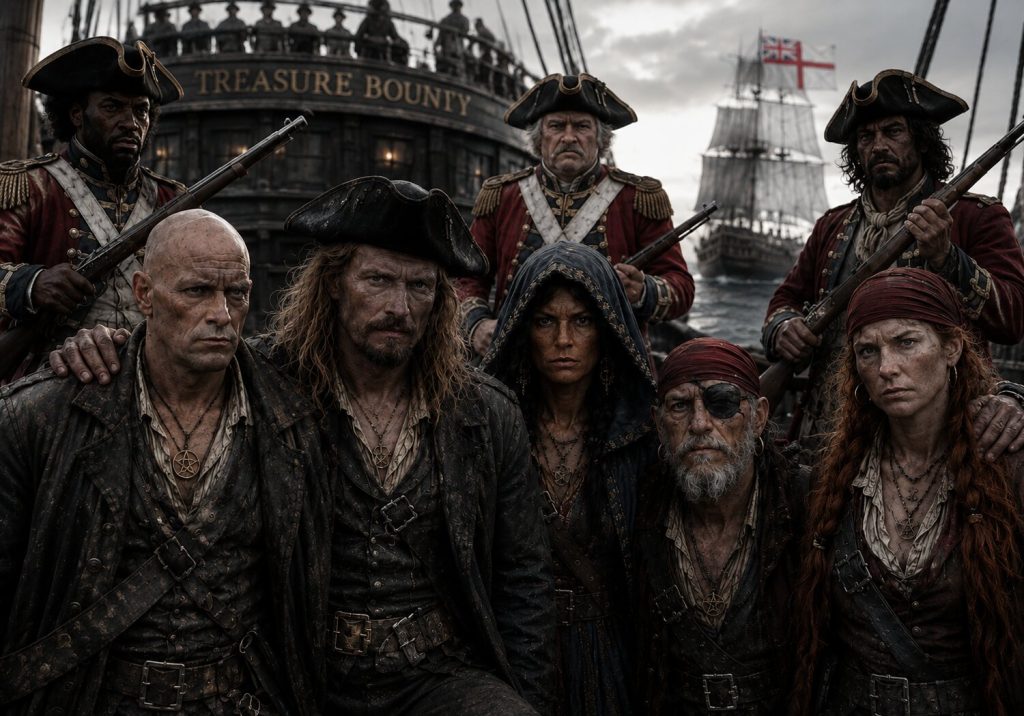
By noon they were on us. Two of His Majesty’s ships, clean-hulled and eager, guns run out just enough to keep the conversation short. We ran anyway — habit, not hope — but the sea had already decided. They came over the rails like debt, and debts, aye, always collect.
No heroics. No last stand. Just boots, ropes, and the cold understanding that this one had been waiting for us. They bound the crew, took the wheel from my hands, and put Treasure Bounty on a leash like a dog that had bitten once too often.
They towed us north, slow and public, through waters that knew my name. Up the Channel. Past men who waved or spat. Into the Thames, where the river narrows and the past starts leaning in close.
The Tower looms different when it’s for ye.
They kept us there two weeks. Stone, dark, and a stink that seeps into yer bones. No rum. No news. Just counting hours by the sound of other men remembering too late what silence costs. The crew held well. Alex said little, which is when ye know he’s paying attention.
When they brought me up, it wasn’t a trial the way folk imagine. No crowd. No shouting. Just a judge doing his duty and a man beside him who did not belong to the bench at all.
The Secretary of State doesn’t need to raise his voice. He speaks like the room already owes him obedience.
He told me they’d been hunting us since an earlier grab in the Caribbean — smaller than Jamaica, but clever, and clever leaves marks. Said my name had travelled places I hadn’t, and that legends grow inconvenient when they start teaching other men how to behave.
He called me a tactician. An escapist. Said the Crown admired skill, provided it knew where to point it.
Then he laid it out plain.
The rope was ready. Clean hemp. Quick work. My crew would follow, one by one, and the story would end tidy enough for the papers.
Or —
I could sail again.
That got my attention.
Not because I feared the rope.
Any man who spends long enough at sea makes peace with that eventually.
But because men in power rarely offer anything without first deciding what it will cost ye.
The Secretary reached into a leather folio and withdrew a single folded sheet.
Old paper.
Old ink.
Old trouble.
He laid it between us.
I looked down.
Ships.
Dates.
Ports.
Amounts.
Crossed-out names.
Missing entries.
The sort of thing Flint would stare at for three days without blinking.
“What am I looking at?”
“What remains.”
I waited.
He said nothing.
After a while I spotted it.
Plymouth.
Then again.
And again.
The name kept surfacing like a body that refused to stay sunk.
“What is it?”
“A copy.”
“Of what?”
“A ledger once held at the Plymouth Custom House.”
That sounded disappointing.
He must’ve seen it on my face.
“Most men react that way.”
“Most men haven’t spent two weeks waiting for a rope.”
That earned a smile.
Small thing.
Gone quick.
“The official books recorded cargoes, duties, arrivals and departures,” he said.
“And?”
“This one recorded what didn’t.”
Now he had me.
The Secretary tapped the page.
“When Spanish prizes came into port, the official account recorded what was declared.”
I nodded.
“When salvage was recovered, the official account recorded what was found.”
“Aye.”
“This ledger recorded what was missing.”
The room went quiet.
I looked back at the paper.
Missing cargoes.
Undeclared recoveries.
Ships that escaped.
Silver reported by sailors but never entered into the books.
Treasure left aboard wrecks.
Cargoes that vanished between sea and shore.
The sort of things honest men forget and dishonest men become rich from.
“Treasure?” I asked.
“Occasionally.”
I didn’t like that answer.
Men who say occasionally usually mean yes.
“The rest?”
“The rest became fortunes.”
Now that interested me.
Fortunes leave marks.
Big houses.
Fine clothes.
Families that suddenly start speaking like they’ve always owned land.
I looked down at the page again.
There was enough written there to make a greedy man hopeful and a careful man nervous.
“What does the Crown want?”
“The names.”
“Whose?”
“The men who benefited.”
I laughed.
“Two hundred years of sailors, merchants, customs men and thieves?”
“Something like that.”
“And if I happen to find a little silver along the way?”
For the first time all afternoon, the Secretary laughed.
A proper laugh.
Short.
Honest.
“Captain, if there were no silver, no gold, and no fortunes buried beneath this matter, you would not be sitting in this room.”
That was the most truthful thing he’d said since we met.
He asked if I understood.
Truth be told, I understood perfectly.
The Crown wanted names.
I wanted whatever had made those names worth remembering.
The following morning they returned Treasure Bounty.
Hull sound.
Crew released.
Stores full.
No apology.
No explanation.
Just freedom.
We dropped downriver on the evening tide, London pretending not to watch.
The Tower faded behind us.
Ahead lay Plymouth.
A missing ledger.
A trail older than the ship itself.
And, if the whispers were true, enough lost silver, forgotten cargoes and unanswered questions to fill a man’s pockets several times over.
Aye.
That sounded worth sailing for.