
Plymouth,
24 May 1572
Most folk think ports are built for ships.
I have never found this entirely convincing.
Ships come and go.
Cargo comes and goes.
Coin comes and goes.
Even sailors eventually come and go, though some require encouragement.
What remains are the routes.
The habits.
The rumours.
The patterns.
A port is merely the place where such things become visible.
I first began noticing this properly on the morning Francis Drake sailed from Plymouth.
Not because Francis was famous.
He wasn’t.
He was simply Francis.
A sailor from Devon.
A friend.
And, on that particular morning, a man attempting to leave Plymouth whilst half the town watched him do it.
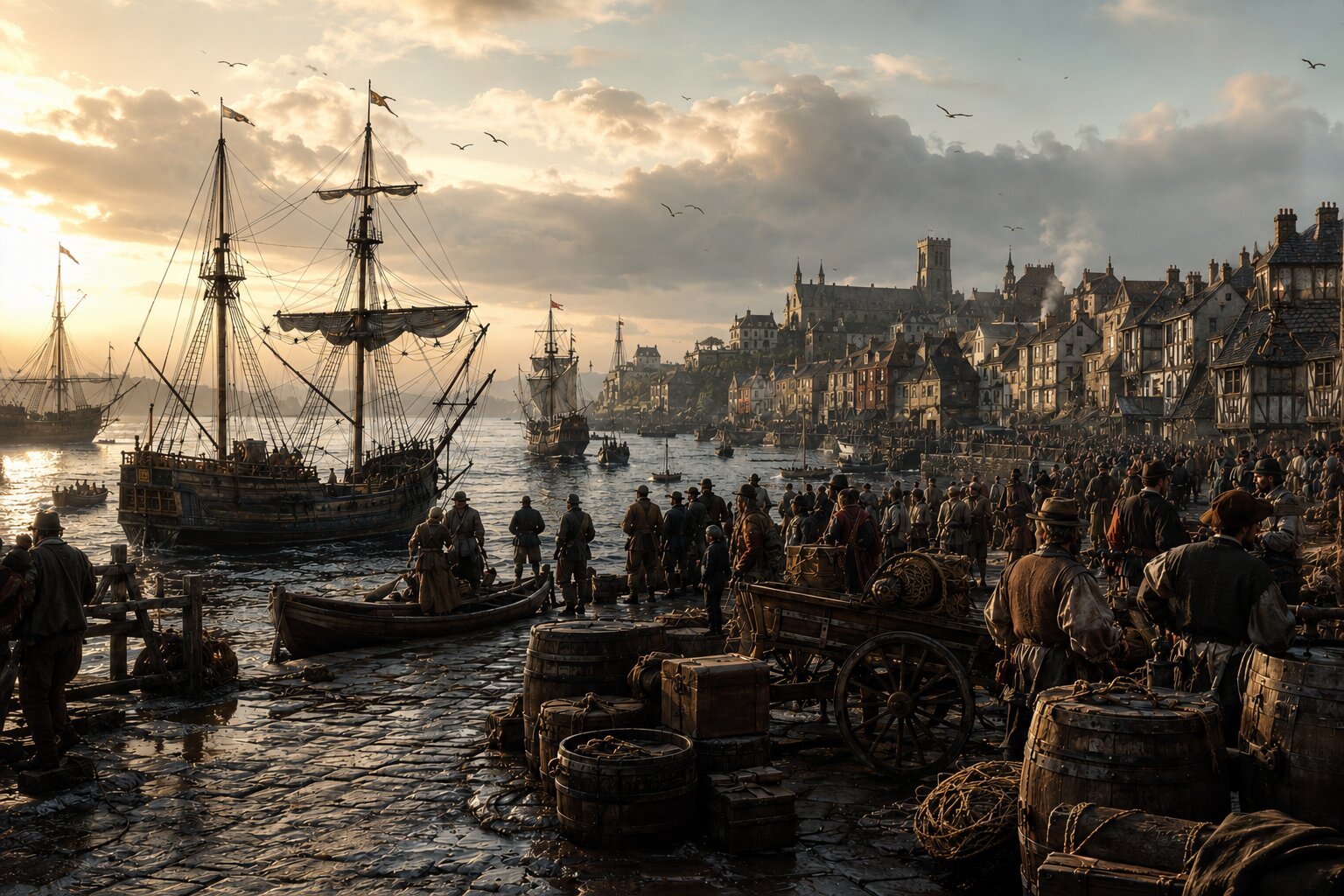
The Pascha sat alongside the quay.
The Swan nearby.
Both vessels had attracted more attention than was healthy.
Not that anyone admitted it.
Officially, people had arrived to conduct entirely unrelated business.
Unofficially, everyone wished to know where Francis was going.
The difficulty was that Francis had become remarkably skilled at avoiding that conversation.
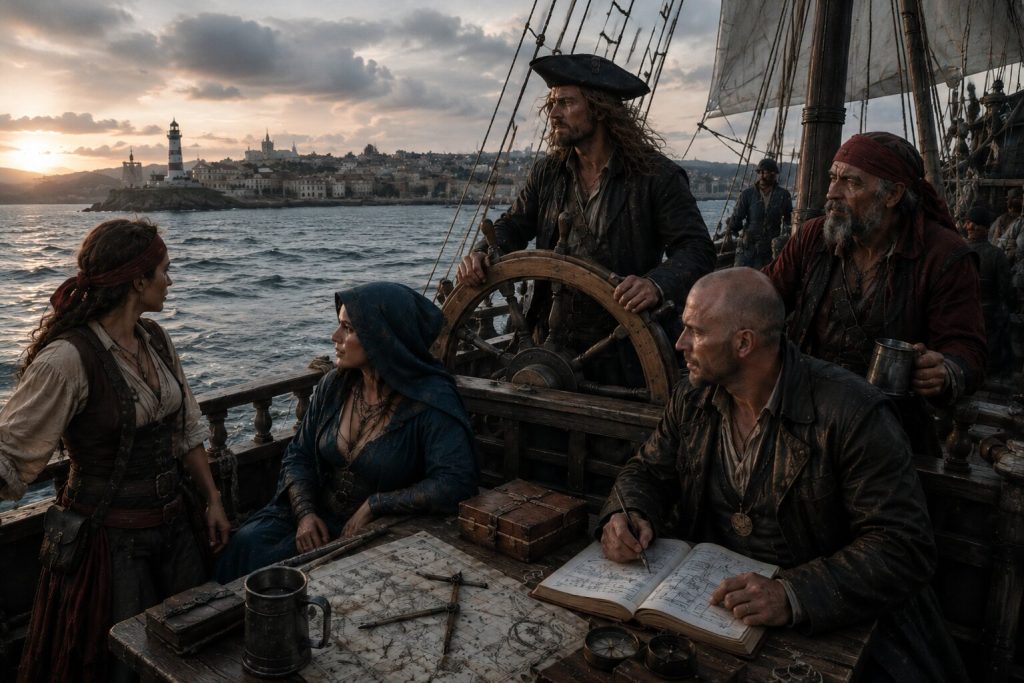
Treasure Bounty lay further along the waterfront.
We had spent the better part of several years carrying goods between ports around the British Isles.
Plymouth.
Bristol.
Cork.
London.
Portsmouth.
And anywhere else willing to pay sensible coin for unsensible amounts of cargo.
The work was honest.
Mostly.
Predictable.
Usually.
And considerably less exciting than whatever Francis appeared to be preparing.
Rumfellow was helping load supplies.
At least that was his version of events.
Others might have described his contribution as standing near barrels and issuing opinions.
“Careful wi’ that one.”
The sailor carrying the barrel ignored him.
Rumfellow nodded approvingly.
“Good lad. That’s exactly what I’d have done.”
Flint stood nearby holding a tally sheet.
Nobody had asked him to.
Flint rarely waited for permission where numbers were concerned.
“How many now?” asked Rumfellow.
“The same number as when ye asked two minutes ago.”
“I were hopin’ fer improvement.”
“The barrels be not breedin’.”
“Shame.”
Lady Marrow laughed softly.
“Give him time. He’ll find a way to tax them next.”
Francis appeared a moment later carrying a coil of rope over one shoulder.
“Tax what?”
“The barrels,” said Lady Marrow.
“A sensible proposal.”
“I knew ye’d agree.”
Francis grinned and continued on his way.
The morning carried on much the same.
Sailors moved cargo.
Merchants appeared.
Shipwrights inspected things that had already been inspected.
Questions were asked.
Answers were avoided.
The harbour grew steadily busier.
That interested me.
Not the ships.
The people.
Every few minutes another face appeared.
A merchant who rarely left his warehouse.
A captain who rarely left his vessel.
A trader suddenly interested in voyages.
An investor suddenly interested in sailors.
Individually they meant little.
Together they formed a pattern.
Something was leaving Plymouth.
And before it had even departed, people were already arranging themselves around its return.
I have always found this worth noting.
Near midday another familiar face appeared upon the quay.
Not a merchant.
Not a sailor.
Not yet.
Merely Francis’s younger cousin Walter.
The lad had not seen many more than twenty summers and possessed the restless habit of staring towards the sea whilst standing firmly upon land.
I had noticed the condition before.
It rarely improves.
Walter exchanged greetings with Francis before wandering across towards us.
Rumfellow spotted him first.
“Well now. Young Walter.”
Walter smiled.
“Cap’n.”
“Ye’ve arrived just in time ter avoid all t’work.”
“I planned it carefully.”
“Aye. I can see that.”
Flint glanced up.
“Come ter see yer cousin off?”
“Aye.”
“So has half o’ Plymouth.”
Walter looked around the crowded quay.
“Looks like it.”
Rumfellow folded his arms.
“Any idea where Francis be headed?”
Walter laughed.
“I was hopin’ one of ye knew.”
“If we did, lad, we’d likely be aboard wi’ him.”
That earned a laugh from all of us.
Walter remained for a while afterwards.
Watching the ships.
Watching the harbour.
Watching Francis.
I noticed something then.
The same thing I had seen in ambitious men before.
He was not watching the voyage.
He was imagining himself upon one.
The tide continued rising.
The crowd continued growing.
And eventually there came that strange moment every departure reaches.
The work ends.
The waiting begins.
The harbour grew quieter.
Not silent.
Plymouth has never been silent.
Merely expectant.
The sort of mood that settles over a place immediately before something changes.
Francis stepped aboard.
John followed.
Orders were shouted.
Lines were cast loose.
Crew moved quickly.
The Pascha edged away from the quay.
The Swan followed.
Families waved.
Friends shouted final remarks.
Several sailors attempted to offer advice considerably too late to be useful.
The ships drifted steadily towards Plymouth Sound.
Slowly.
Then surely.
Then beyond conversation.
We watched from the waterfront.
The sails grew smaller.
The vessels became distant shapes.
Eventually the horizon claimed them.
And that was that.
Months of preparation disappeared westward.
The crowd began dispersing almost immediately.
Markets reopened.
Merchants returned to business.
Dockworkers searched for fresh cargo.
The harbour moved on.
Ports rarely remain sentimental for long.
By evening we found ourselves in the Minerva.

The matter had not been planned.
Most worthwhile matters rarely are.
The tavern was full.
Sailors crowded the larger tables.
Merchants occupied the corners.
The ale was acceptable.
The opinions were not.
Every conversation seemed to concern Francis Drake.
One man claimed he was bound for Spain.
Another claimed the Caribbean.
A third appeared convinced he was sailing to the edge of the world.
Rumfellow tolerated perhaps ten minutes of this.
Then abandoned the effort.
“None o’ these fools know where he’s gone.”
“That has never prevented them explainin’ it,” said Lady Marrow.
The room laughed.
Rumfellow drank.
Flint counted something.
Alex listened.
I watched.
At first I noticed nothing.
Then I noticed everything.
A merchant discussing Bristol.
A sailor describing Cork.
A fisherman talking of French vessels.
Someone mentioning London.
Someone else mentioning Antwerp.
Further across the room a captain spoke of Lisbon.
Near the fire another spoke of Newfoundland.
Every table seemed connected to somewhere else.
The room felt larger than the building containing it.
Not physically.
Geographically.
That interested me.
Plymouth was not merely a port.
It was a meeting point.
A place where routes crossed.
Where departures became arrivals elsewhere.
Where news arrived before ships.
Where opportunities arrived before news.
The thought settled into my mind and refused to leave.
“What be turnin’ them gears then?” asked Rumfellow.
“The room.”
“It be a tavern.”
“Aye.”
“We’ve seen taverns before.”
“Not this one.”
He followed my gaze.
Merchants.
Captains.
Sailors.
Letters.
Rumours.
News.
Destinations.
Every conversation pointed towards another harbour.
Another coast.
Another possibility.
Lady Marrow noticed it too.
“She’s found a pattern.”
Flint closed his tally book.
“God help us.”
“Nay,” said Rumfellow. “God help whichever poor bastard be caught in it.”
The table laughed.
Even Alex smiled.
“What pattern?” asked Rumfellow.
I looked around the room once more.
Then towards the harbour beyond the window.
Lanterns moved across dark water.
Ships arrived.
Ships departed.
The tide continued its work.
“Everything passes through ports.”
Rumfellow frowned.
“Ships?”
“Aye.”
“Cargo?”
“Aye.”
“Anything else?”
“People.”
“Aye.”
“Coin.”
“Aye.”
“News.”
“Aye.”
“Trouble.”
“Especially trouble.”
Lady Marrow nodded.
“Influence as well.”
Flint added another.
“Money.”
“Always money.”
Alex finally spoke.
His voice remained irritatingly reasonable.
“The interesting thing is not the ports themselves.”
Rumfellow looked at him.
“What then?”
“The connections between them.”
The table fell quiet.
Because we all understood what he meant.
We had spent years moving between ports.
Yet somehow we had never truly looked at them.
Not properly.
Not as a network.
Not as a map.
Not as a system carrying people, fortunes, rumours, opportunities and ambitions from one shore to another.
Rumfellow raised his tankard.
A dangerous sign.
Important decisions often begin that way.
“Well then.”
Flint sighed.
Lady Marrow smiled.
I already knew what was coming.
“What now?” I asked.
“We leave.”
“For where?”
“We’ll decide that later.”
“That is not a plan.”
“It be t’beginning of one.”
“It isn’t.”
“It might become one.”
The room laughed again.
Yet the idea refused to disappear.
Not because of Francis.
Not entirely.
Because of the ports.
The routes.
The movement.
The endless chain connecting one harbour to another.
I thought again of the conversations surrounding us.
Bristol.
London.
Cork.
Lisbon.
Antwerp.
Newfoundland.
Places represented only by rumours and sailors.
Yet somehow present all the same.
A map was beginning to reveal itself.
The worthwhile ones usually do.
The decision was made before the evening ended.
Treasure Bounty would sail within days.
No royal commission.
No grand purpose.
No carefully considered strategy.
Merely curiosity.
Which has launched considerably more voyages than wisdom ever managed.
At the time I believed Francis Drake had given us a direction to sail.
Looking back, I suspect we were following something larger.
The routes between ports.
The movement of the world.
And once one begins paying attention to such things, it becomes remarkably difficult to stop.
— Penny Doubloon