Regarding a Request Received in Plymouth

Plymouth,
Summer, 1556
The trouble with inheritances is that most people mistake them for possessions.
They are not.
A ship may be inherited.
A warehouse may be inherited.
A ledger may be inherited.
Coin may be inherited.
Trust cannot.
Trust must be earned again by every generation.
I was considering this whilst climbing the stairs to the Hawkins counting house.
The elder William Hawkins had been gone scarcely two years.
Yet his name remained everywhere.
Upon ships.
Upon cargoes.
Upon letters.
Upon conversations.
Plymouth still spoke of him as though he had merely stepped ashore for the afternoon.
His sons had inherited many things.
Among them was the burden of proving they deserved them.
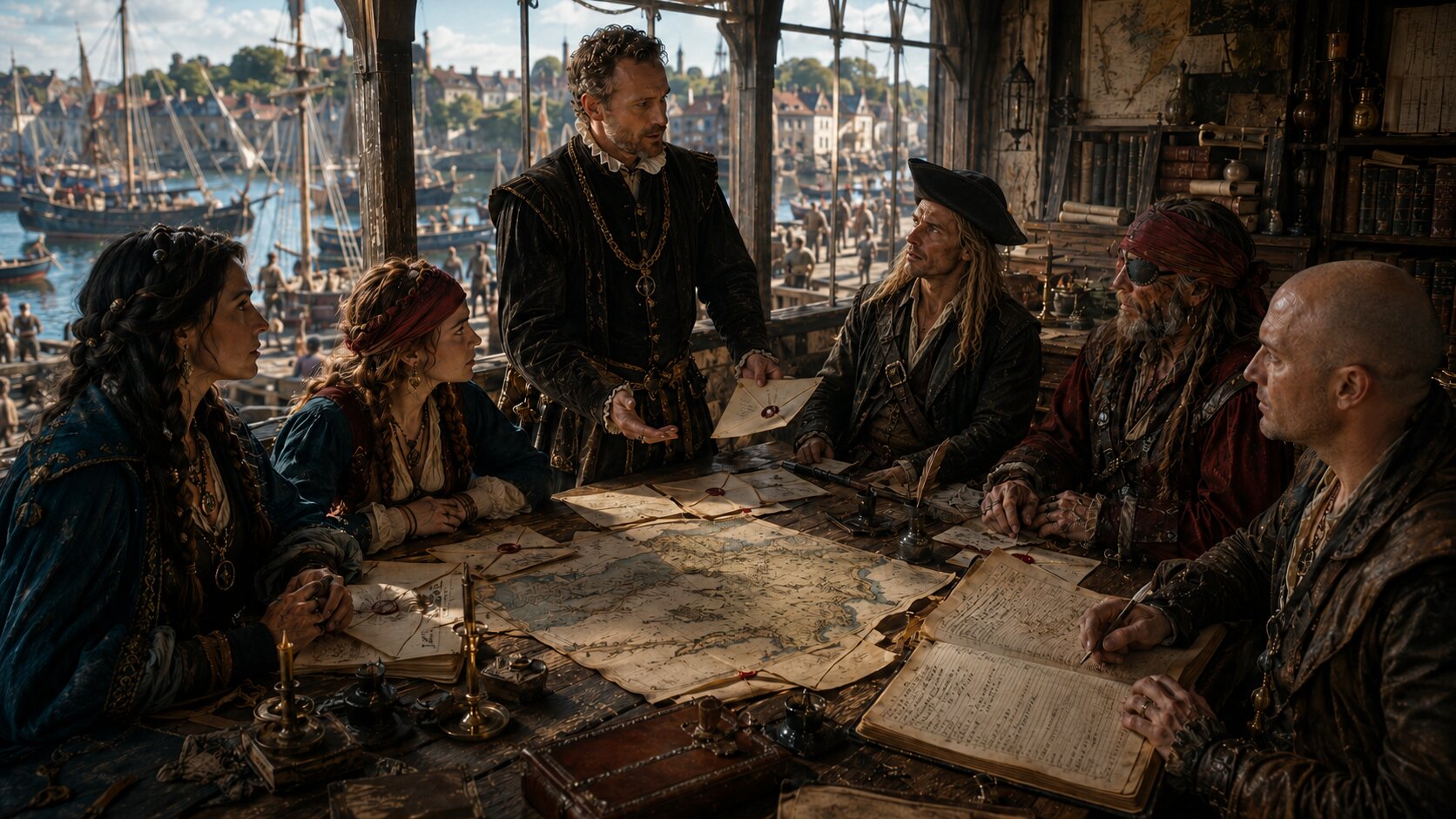
The office overlooked the harbour.
A sensible arrangement.
Merchants who cannot see their ships tend to become nervous.
The room smelled of ink.
Tar.
Salt.
And ambition.
The latter was strongest.
William Hawkins stood beside the window studying the waterfront below.
In the years since becoming a Freeman of Plymouth, he had become increasingly involved in the affairs of the town. Ships interested him. Trade interested him. Plymouth interested him.
His younger brother John occupied the opposite side of the room and appeared considerably less interested in paperwork.
The contrast was already becoming apparent.
William was helping shape Plymouth.
John seemed determined to discover what lay beyond it.
The sea had already begun whispering to him.
Penny had discovered a table covered in correspondence.
Flint had discovered the ledgers.
Rumfellow had discovered a chair.
Alex had discovered silence.
The usual arrangements had therefore been achieved.
William greeted us warmly.
A quality I have always admired in successful men.
Many abandon it far too quickly.
“Lady Marrow.”
“Master Hawkins.”
“I trust ye found the place.”
“It overlooks half of Plymouth.”
“Aye.”
“That generally helps.”
John laughed.
William ignored him.
The sign of a practiced brother.
Penny had already begun reading.
Another dangerous sign.
“What exactly are we looking at?”
William crossed the room.
The harbour shifted behind him.
Sails.
Masts.
Cargo.
Movement.
The endless business of a growing port.
“A decision.”
That held my attention.
Few things alter the course of families more quickly than decisions.
William placed several letters upon the table.
London.
Southampton.
Bristol.
And one from further afield.
Considerably further.
Antwerp.
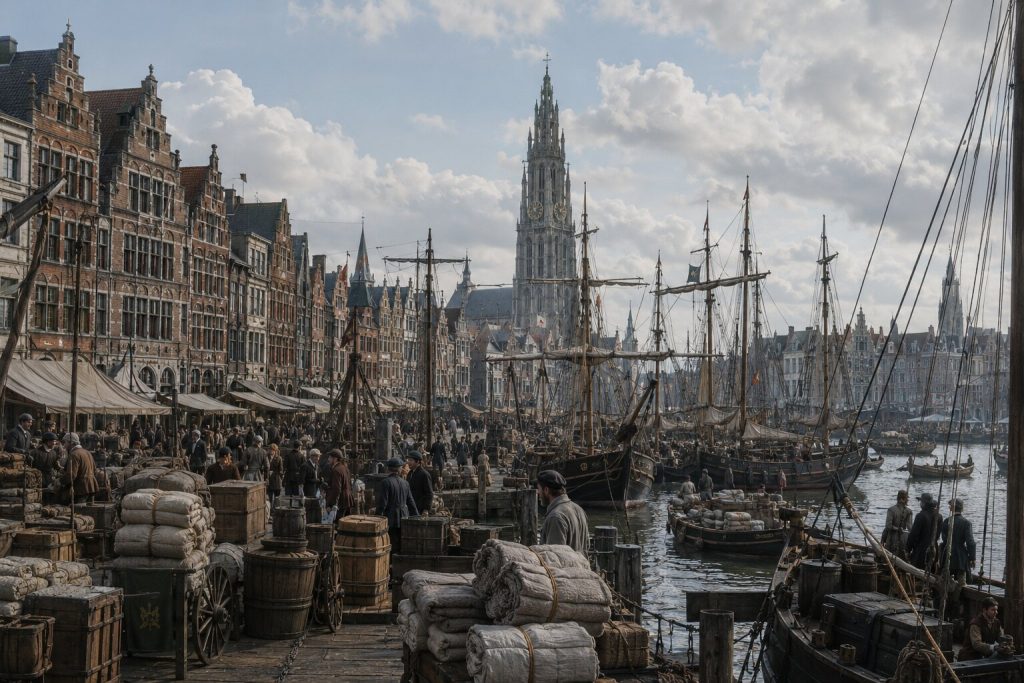
Penny reached for it immediately.
I expected nothing less.
“What of it?”
William smiled.
“Read it.”
She did.
The room grew quieter.
Then quieter still.
Finally she looked up.
“Who are the Schetz?”
John laughed.
“A question I’ve been hearing all month.”
William nodded.
“Aye.”
The name appeared again.
And again.
And again.
Different letters.
Different merchants.
Different transactions.
The same family.
Schetz.
Schetz.
Schetz.
Like church bells striking the same hour.
Flint looked up from a ledger.
“Antwerp?”
“Aye.”
“Important?”
“Apparently.”
Rumfellow frowned.
“Apparently?”
“Aye.”
“That sounds expensive.”
John laughed again.
William did not.
That told me considerably more than either intended.
“The family has interests in trade.”
Penny raised an eyebrow.
“So do half the merchants in Europe.”
“Aye.”
William handed her another letter.
“And banking.”
Another.
“And shipping.”
Another.
“And credit.”
Another.
“And royal finances.”
The room fell silent.
Even Rumfellow recognised the significance.
Not because he understood banking.
Because he understood power.
Power leaves a particular scent.
This room suddenly possessed it.
I studied the letters more carefully.
Not the goods.
Not the figures.
The introductions.
The recommendations.
The references.
The same family appearing in different places.
The same family trusted by different people.
The same family opening different doors.
That interested me.
Families often reveal themselves through relationships long before they reveal themselves through wealth.
John finally spoke.
“If half of what’s written here be true, they know everyone.”
William shook his head.
“Nay.”
The room looked towards him.
“I suspect they know the people who matter.”
That was considerably more interesting.
Penny unfolded a map.
Maps appear whenever Penny believes the world is hiding something.
Antwerp emerged beneath her fingers.
Then the routes surrounding it.
The rivers.
The ports.
The roads.
The connections.
Always the connections.
“What do they want?” she asked.
William handed her the final letter.
She read it carefully.
Then passed it across.
The request was simple.
A meeting.
Not to discuss one cargo.
Nor one voyage.
Nor one transaction.
But the possibility of future dealings between houses.
The sort of conversation that begins quietly and ends years later in places nobody expected.
I looked towards William.
“You are considering it.”
“Aye.”
“You are uncertain.”
“Aye.”
John smiled.
“He’s been uncertain for three weeks.”
“I’ve been careful.”
“You’ve been uncertain.”
The distinction appeared important only to William.
I understood both positions.
Partnerships create fortunes.
They also create disasters.
The difficulty is knowing which before the paperwork is signed.
William looked around the room.
At Penny.
At Flint.
At Alex.
At Rumfellow.
Finally at me.
“My father spent years building relationships.”
Nobody disagreed.
“He always said the same thing.”
“What was that?” asked Penny.
William glanced towards the harbour.
Towards the ships bearing his family name.
Towards the city helping shape their future.
Then back towards the letters.
“When the same name keeps appearing, find out why.”
The room remained silent.
Outside, a ship departed Plymouth.
Another arrived.
The tide continued its work.
Inside, another sort of journey had begun.
Not in search of treasure.
Nor pirates.
Nor kings.
But families.
The houses that controlled trade.
The relationships that moved fortunes.
The agreements that shaped ports.
And the deals that connected one great house to another.
Treasure Bounty would sail before summer’s end.
Our destination was Antwerp.
Our purpose considerably less certain.
We had been asked to discover whether a family we had never met was worth knowing.
Looking back, it was the first of many such questions.
— Lady Marrow